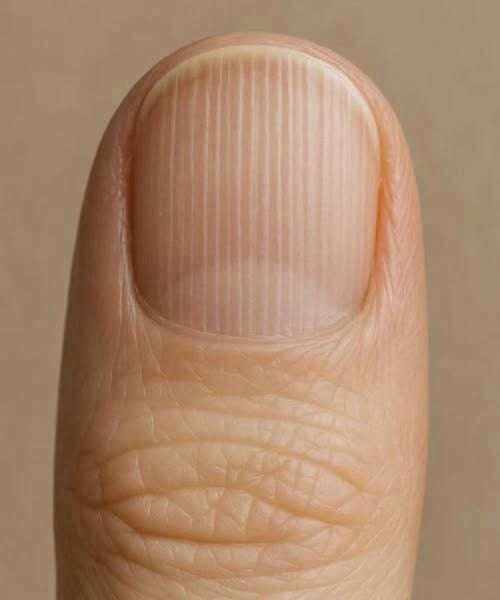
This striking macro photograph captures an extremely close-up, top-down perspective of a human thumb, focusing entirely on a highly pronounced pattern of vertical nail ridging. The entire frame is dominated by the symmetrical, vertical alignment of the finger, which draws the viewer’s eye directly up and down the length of the nail plate. The nail itself is semi-translucent, showcasing a natural, healthy pale-pinkish hue that stems from the active blood vessels of the nail bed underneath. Running flawlessly from the very base of the cuticle to the free edge of the tip are dozens of fine, raised, and perfectly parallel lines. This unique texture, medically known as longitudinal striations, gives the nail an appearance closely resembling fine corduroy fabric or gently raked sand. The ridges are remarkably uniform in their spacing, creating a highly organized, almost mathematical pattern across the keratin surface. At the very top edge of the nail, just before it separates from the skin, a subtle, slightly darker yellowish-tan band is visible. Near the base of the nail, the lunula—the pale, half-moon-shaped area pointing toward the root—is faintly visible beneath the surface. However, its typically smooth white surface is heavily crossed and textured by the continuous flow of the rising vertical ridges.
The cuticle at the bottom of the nail plate is exceptionally neat, clean, and well-defined, forming a perfect semi-circular boundary. There are absolutely no signs of dry skin, painful hangnails, or inflammation around this delicate border, indicating excellent personal care. Below the cuticle, the skin of the thumb transitions into a highly detailed landscape of natural micro-textures, wrinkles, and deep creases. These intricate folds run horizontally across the joint of the knuckle, showcasing the realistic elasticity and complexity of the human epidermis. The skin itself has a healthy, warm, pale-beige coloration that perfectly frames the lighter tones of the fingernail. To capture such fine details, the photographer utilized exceptionally soft and highly diffuse lighting from directly above. This gentle illumination eliminates any harsh glare or distracting specular highlights on the semi-glossy surface of the keratin. It also casts tiny, subtle shadows in the microscopic valleys between the ridges, beautifully emphasizing their three-dimensional depth.
The camera employs a very shallow depth of field, keeping only the central and lower portions of the nail plate in razor-sharp focus. As a result, the very tip of the nail and the lateral folds of the skin gently soften into a smooth, dreamy blur. The background is completely out of focus, consisting of a solid, warm neutral-beige tone that prevents any visual distraction. This clean composition transforms a simple anatomical feature into a captivating, artistic study of human biology. While horizontal lines on a nail can sometimes point to systemic illness, these vertical grooves are typically a harmless, benign trait. In fact, they are a very common physical characteristic that often develops or becomes more prominent as a natural part of the aging process. Just as our skin naturally develops wrinkles over time, the nail matrix slows down its cellular production, leading to these parallel ridges. This image provides an excellent visual reference for dermatologists, medical students, or anyone interested in nail health. It highlights how even the smallest parts of our bodies carry their own intricate, beautiful patterns of development. Looking at the image, one cannot help but appreciate the incredible level of detail captured by modern macro photography. The seamless blend of medical clarity and aesthetic beauty makes this photograph truly stand out. It serves as a gentle reminder that our bodies are constantly changing, leaving unique textures as markers of our life’s journey. Ultimately, this detailed shot of a ridged thumbnail stands as a fascinating monument to the quiet, natural complexity of human anatomy.