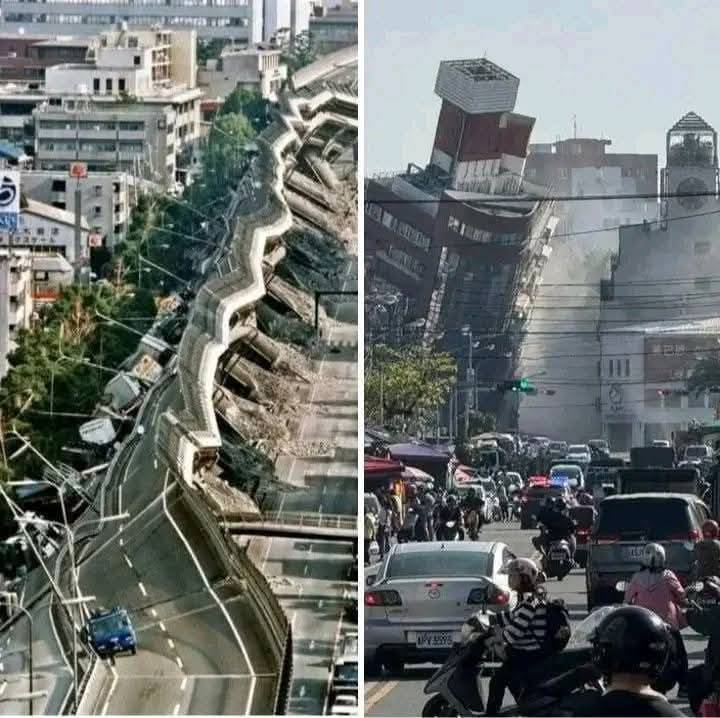
The video displays a split-screen presentation showing simulated or edited footage of a catastrophic earthquake striking a major urban area. On the left side of the screen, an aerial perspective captures a long, elevated highway running through a city. The asphalt road begins to ripple and bend violently in a wave-like motion, defying physics. Vehicles on the road bounce up and down precariously as the structural failure progresses. Major cracks open up along the seams of the highway, sending plumes of concrete dust and dirt into the air. Entire sections of the adjacent retaining walls crumble and fall away from the main roadway structure. The undulating movement of the asphalt creates a chaotic scene as cars try to maintain their balance. Meanwhile, the right side of the screen captures a street-level view of a bustling city intersection filled with traffic. Numerous cars, vans, and motorcycles are stopped or moving slowly through the active roadway area. In the background of this frame, a tall, multi-story building can be seen tilting at an extreme angle. The building has a reddish-brown facade topped with a distinct white structure on its roof. Suddenly, the entire building begins to slide and collapse forward onto the street below. As it falls, sections of the roof and facade break apart, throwing large chunks of debris everywhere. A massive, dense cloud of thick gray dust erupts instantly upon the building’s impact. The falling structure snaps power lines, causing sparks and creating an immediate hazard for the street. People on motorcycles and in cars watch in utter panic as the building comes crashing down towards them. The dust cloud rapidly expands across the intersection, obscuring the nearby shops and market stalls. The left frame continues to show the highway buckling further, creating deep trenches where the road once stood. The visual editing simulates an apocalyptic scenario of total infrastructure failure across multiple zones. The continuous background audio track features a deep, low-frequency rumbling sound that simulates seismic activity. The roar of collapsing concrete and crashing structures is overlaid to enhance the dramatic effect. The synchronization between the two panels highlights the widespread nature of the simulated disaster. The buildings adjacent to the highway on the left remain remarkably unaffected, revealing the edited nature of the clip. The vehicles at the intersection on the right appear static or unbothered, contrasting with the destruction behind them. The sky on both sides of the screen is clear and blue, making the dust and debris stand out sharply. The intense imagery serves as a powerful depiction of structural collapse and environmental chaos. The video focuses heavily on the raw power of the simulated earthquake forces on modern architecture. The camera angles remain fixed to provide a steady look at the escalating destruction in both frames. This short compilation leaves a lasting impression of the fragility of urban structures during a crisis. The footage concludes while the dust clouds are still expanding across the entire screen layout.