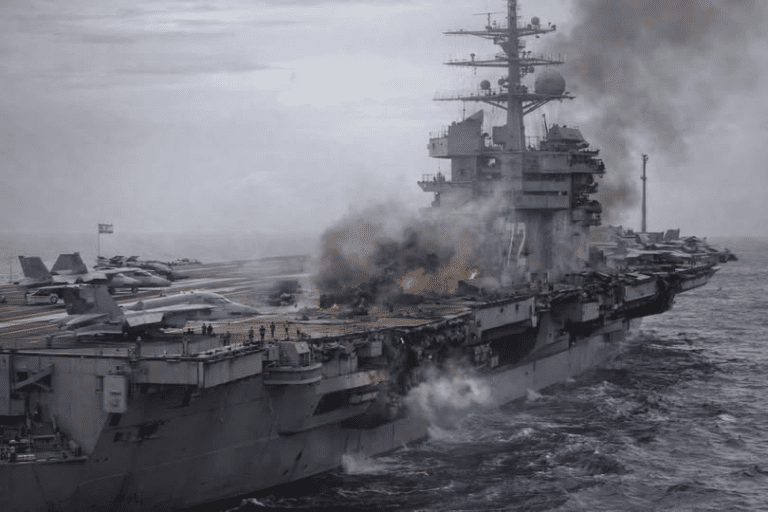
The video captures a dramatic scene of a major fire on the flight deck of a large military aircraft carrier at sea. The aircraft carrier is positioned in the middle of a vast, calm ocean under a cloudy, overcast sky. A large column of thick, black smoke billows into the air from a damaged section of the flight deck. On the left side of the flight deck, several military fighter jets are parked in a neat row. One of the fighter jets in the background displays the distinct green, white, and red flag of Iran on its tail fin. The superstructure of the aircraft carrier prominently displays the hull number 72 in large white numerals. A group of emergency personnel or firefighters wearing protective gear is gathered near the burning wreckage. They are actively deploying a fire hose to spray water onto the core of the blazing inferno. On the lower side of the ship’s hull, a powerful water cannon discharges a stream of water into the ocean. The water from the cannon creates a large cloud of white spray against the grey metallic side of the ship. Severe structural damage is visible on the hull directly below the burning section of the flight deck. The metal cladding around the opening is charred, blackened, and twisted from the immense heat. Small patches of flame can be seen licking through the open gaps in the damaged hull area. As the clip begins, the primary fire burns intensely, creating a sense of immediate danger and urgency. Suddenly, a massive secondary explosion erupts violently from the center of the damaged deck area. A bright orange and yellow fireball expands rapidly upward and outward into the dark smoke column. The sudden blast sends sparks, debris, and smaller fragments flying into the air surrounding the ship. In response to the explosion, the firefighters on the deck immediately turn and begin to run for safety. They scatter in different directions across the open flight deck to escape the intense thermal wave. The sound of a roaring alarm or siren blares continuously in the background of the video. Distant shouting and chaotic noises add to the high-stakes atmosphere of the naval emergency. The camera remains mostly stable, capturing the entire unfolding disaster from an elevated, steady angle. The dark smoke becomes denser after the explosion, partially obscuring the ship’s tall superstructure. The parked fighter jets remain stationary, unaffected by the nearby blast on the opposite side of the deck. The water cannon continues to discharge a heavy stream, attempting to cool the internal compartments of the vessel. The water spray mixes with the rising smoke, creating a complex visual of steam, soot, and ash. The modern naval architecture of the vessel is characterized by its expansive flat deck and complex radar towers. The contrast between the grey sky, grey ocean, and bright orange fire creates a very striking visual composition. The speed of the escaping crew members highlights the intense panic and danger of the situation. The fireball reaches its peak height within a single second before beginning to dissipate into the smoke cloud. The vertical lines of the ship’s main mast contrast sharply with the organic, expanding shapes of the explosion. The layout of the ship shows that the incident is concentrated on the starboard side of the flight deck. Multiple hoses appear to be connected to internal water sources to combat the growing disaster. The ocean surface reflects the dim, diffused light from the heavy cloud cover above. The presence of the foreign flag on the parked jet introduces a politically charged element to the footage. Debris from the explosion litters the surrounding deck area, creating additional hazards for the response team. The charred metal on the hull shows the long-lasting impact of the extreme temperatures generated by the fuel fire. The video tracking focuses purely on the immediate area of the explosion and the reacting personnel. The number 72 is clearly legible against the dark grey paint of the island structure. The white water spray from the hull creates a strong diagonal line across the lower half of the frame. The firefighters wear heavy, insulated suits designed to protect them from extreme radiant heat. The wind seems to be pushing the thick smoke cloud toward the rear and right side of the vessel. The entire sequence unfolds in real-time, capturing a snapshot of high-intensity crisis management. The light from the explosion momentarily brightens the faces of the nearby crew members. The surrounding ocean remains vast and empty, emphasizing the isolation of the military ship. The structural opening in the hull reveals multiple decks within the carrier that may be affected by the fire. The continuous loop of the background noise maintains a sense of ongoing emergency from start to finish. The text and numbers on the hull help identify the vessel as a Nimitz-class aircraft carrier. The video concludes with the smoke continuing to rise heavily as the crew works to contain the damage. This short, dramatic clip effectively conveys the immense scale and danger of a major maritime disaster.