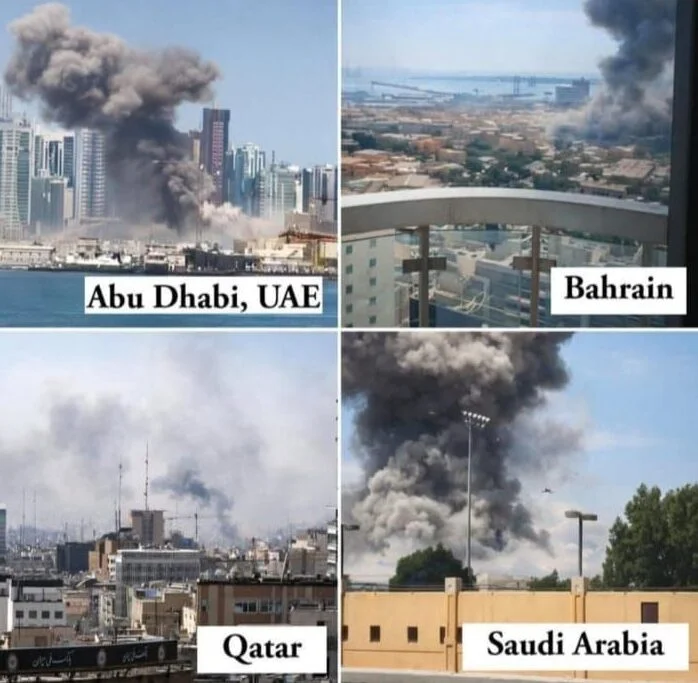
The video displays a split-screen layout containing four different panels that show dramatic scenes of fighter jets and explosions. In the top-left panel, labeled “Abu Dhabi, UAE,” a massive column of dark smoke rises from the ground near a city skyline. A sudden, bright explosion erupts at the base of the smoke cloud, sending a shockwave through the immediate area. A fighter jet suddenly emerges from the smoke, flying at high speed directly away from the blast zone. The top-right panel, labeled “Bahrain,” depicts a similar urban coastal setting under a clear blue sky. A jet flies past the camera, leaves a thick trail of white smoke, and performs a sharp loop in the air. A sudden explosion occurs on the ground below, creating a fireball and a dark cloud of debris. The jet loops gracefully around the rising smoke, demonstrating high-speed maneuverability over the city. In the bottom-left panel, labeled “Qatar,” the scene captures a dense urban area with buildings and radio towers. A fighter jet flies low over the rooftops, leaving a curved trail of smoke as it ascends rapidly. It loops backward through its own smoke trail, showcasing precise aerial control during the flight path. The bottom-right panel, labeled “Saudi Arabia,” shows a view from behind a building with a tall light pole. A small jet flies directly across the frame, leaving a looping white smoke trail against a massive dark cloud. The jet maneuvers sharply, carving a tight circle in the sky as it passes by the smoke column. All four panels showcase the jets performing complex and synchronized maneuvers in relation to the smoke. The layout allows viewers to compare the different scenes and locations at the exact same time. The video has a continuous background audio track filled with the loud, roaring sounds of jet engines. The sound effects emphasize the high speed and power of the aircraft shown in the clips. Each panel features a distinct geographical label at the bottom to identify the simulated or real location. The sky in most panels appears clear, which helps to highlight the white smoke trails left by the jets. The contrast between the bright fireballs and the dark, thick smoke creates a very dramatic visual effect. The buildings in the background provide a sense of scale for the height and speed of the aircraft. The video focuses heavily on the action of the jets as they navigate through the smoky environments. The camera angles in each section remain relatively steady, capturing the wide aerial movements of the planes. The jets appear to be military models, built for high performance and agile combat maneuvers. The smoke trails create geometric shapes and loops in the air as the planes change direction. The explosions on the ground are timed closely with the appearance or movement of the aircraft. The entire split-screen presentation creates a chaotic, intense, and action-packed atmosphere for the viewer. The movement of the jets is fluid and rapid, drawing attention from one panel to another. The video combines these scenes together to create a thematic compilation of aerial demonstrations or incidents. The lighting in each panel varies slightly depending on the angle of the sun and the buildings. The black smoke columns are dense enough to partially block out the background scenery in some frames. The jets disappear briefly behind the smoke clouds before re-emerging on the other side. The video highlights the incredible speed and responsiveness of modern fighter jet technology. The proximity of the flights to urban centers adds a layer of tension to the footage. The white trails linger in the air for several seconds after the jets have moved past. The video does not show any people on the ground, keeping the focus entirely on the machines. The visual storytelling relies on the synchronization of the four panels to maintain user engagement. The footage ends while the jets are still actively maneuvering through the smoky skies.