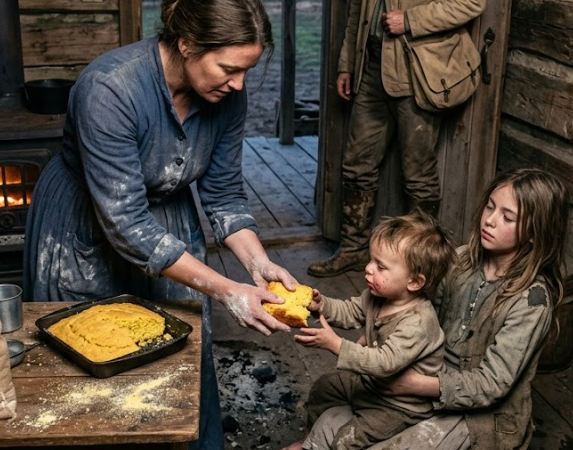
The rancher’s children were starving in silence — Until the town’s most hated widow arrived at his door
Ruth Bell had one boot sunk in Cottonwood Creek mud when the sound from the gray farmhouse died away.
That was what made her stop.
Not the crying. Hunger had a voice, and Ruth knew it. She had heard it in rented rooms where mothers scrubbed shirts until their knuckles split. She had heard it behind barns when boys got whipped for stealing windfall apples. A crying child still had one last bit of faith left in the world.
But this was worse.
It was a thin, worn-out noise, fading into the boards and cottonwoods, like an empty pump still moving after the well had gone dry.
Evening hung low over the creek. Dust clung to the hem of Ruth’s brown dress, and the canvas bag on her shoulder pulled hard against her bones. Three dollars and fifty cents sat folded inside her boot, prize money from honey bread that had won at the Mill Haven Harvest Fair four days earlier.
For one foolish minute, after the judge took that first bite and went quiet, Ruth had thought the town might see her differently.
Then the women looked her over the same way they always did.
Too broad.
Too plain.
Too easy to dismiss.
By sundown, every other woman with a ribbon had work promised for winter. Boardinghouse kitchens. Ranch homes. Families needing hands before the cold settled in. Ruth got polite smiles, softened voices, and doors that closed before she had finished explaining what she could do.
So she tucked her money where desperate fingers would not find it and walked west.
A strange road could not judge her any worse than Mill Haven already had.
Then she heard the boy.
The farmhouse beyond the cottonwoods looked like a place that had forgotten how to be a home. The porch sagged. No smoke lifted from the chimney. No dog barked. No woman moved behind the dull windows. The whole place had that tired, ashamed stillness of people who had stopped asking for help because no one had answered the first time.
Ruth climbed out of the creek.
By the time she reached the porch, there was movement inside. A chair dragged. Small fingers worked the latch. The door cracked open.
A girl of six or seven stood there with a toddler boy on her hip.
Her braid was crooked. Her eyes were not childish. They were steady and watchful, the eyes of someone who had learned too early to measure trouble before it stepped inside.
The boy rested against her shoulder, thin as kindling, his lips dry, his eyes open without really searching.
Ruth kept her voice gentle. “Your pa home?”
“North field,” the girl said.
“What’s your name, honey?”
“Clara.” She shifted the boy higher on her hip. “This is Eli.”
Eli did not answer to his own name. He only breathed.
Ruth looked past them into the dim kitchen. Cold stove. Cold hearth. A flour sack slumped near the wall like it had given up, too.
“When did you last eat?” she asked.
Clara took too long to answer. That told Ruth more than the words did.
“Yesterday,” the girl said. “Some.”
“Some?”
“There’s flour. Pa said he’d bring salt pork from town, but he hasn’t come back yet.”
Ruth set her canvas bag down.
“Is there a stove?”
Clara stepped aside.
That was all the invitation Ruth needed.
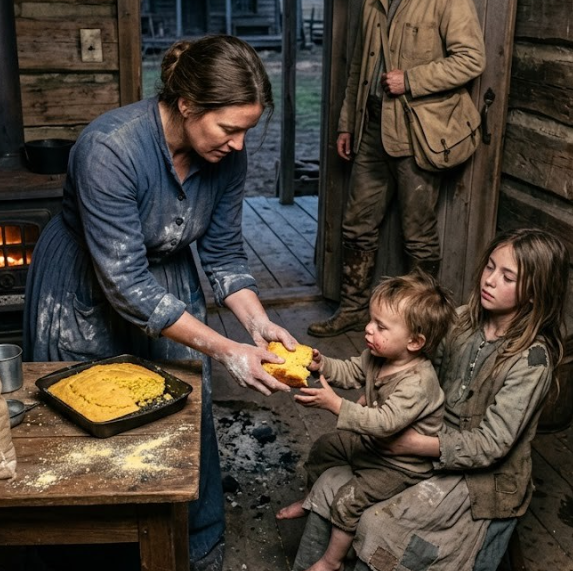
She had the fire lit before the room fully warmed. She found meal, coaxed what she could from the flour sack, and worked with the quiet speed of a woman who had cooked through lean times before. Soon, cornbread was browning in a pan, the smell of it spreading through that poor kitchen like the first honest thing the house had known in days.
Clara sat at the table with Eli in her lap, both of them watching the pan as if looking away might make it disappear.
Then boots sounded on the porch.
The man who came through the door stopped dead.
He was tall, worn down, and lean in the hard way of a rancher who had been giving more than he had to give. Mud streaked his boots. His shirt carried the day’s dust. His face had that hollow, stubborn exhaustion of a man trying to solve a problem with no money, no time, and no mercy left in the season.
He stared at Ruth standing at his stove.
Then at his children.
Then back at Ruth.
“Who—”
“I crossed the creek,” Ruth said, turning the bread before it burned. “I heard your boy. I had flour and meal in my bag. There’ll be enough for tonight.”
His jaw tightened, but not with anger. With shame.
“I don’t have money to pay—”
“I didn’t ask for any yet.”
Ruth set the pan down and looked at him plainly.
“My name is Ruth Bell. I came from Mill Haven. I need work, and no one there would give me any. I can cook, preserve, sew, keep a kitchen running through winter, and manage accounts if there are accounts worth keeping.”
The fire snapped behind her. The room smelled of cornmeal, smoke, and bitter coffee grounds left too long in a pot.
“I won’t take charity,” she said. “And I won’t give it. If you need help in this house, I’ll work for room and board now, and a fair wage when you can pay it.”
The rancher looked as though no one had spoken to him in straight lines for a long time.
“You walked all the way from Mill Haven to ask for work?”
“No,” Ruth said. “I walked here because your son stopped crying. The work came after I saw the kitchen.”
Clara lifted her face from the table.
“Pa,” she whispered, “the bread smells done.”
The man’s name, Ruth would learn, was Caleb Walsh.
That night he sat at his own table like a guest in his own house while Ruth broke cornbread into pieces and put it in front of his children first.
Eli ate with both hands.
One piece. Then another. Then a third.
By the fourth, his head sagged against Clara’s arm, and sleep took him before hunger had fully let go.
Clara kept watching the empty pan, as if she did not trust food to remain real after it left her plate.
Ruth ate standing by the counter, because she was used to eating that way, and because sitting down before the children had enough felt wrong in her bones.
Caleb stared at his sleeping son.
Then at his daughter.
Then at the widow every decent woman in Mill Haven had turned away.
His hand closed around the edge of the table.
For a moment, only the stove made a sound.
Then Caleb looked toward the little room off the kitchen and started to say something that would decide whether Ruth Bell had found work…
Or whether she would be sent back into the dark with three dollars and fifty cents hidden in her boot.